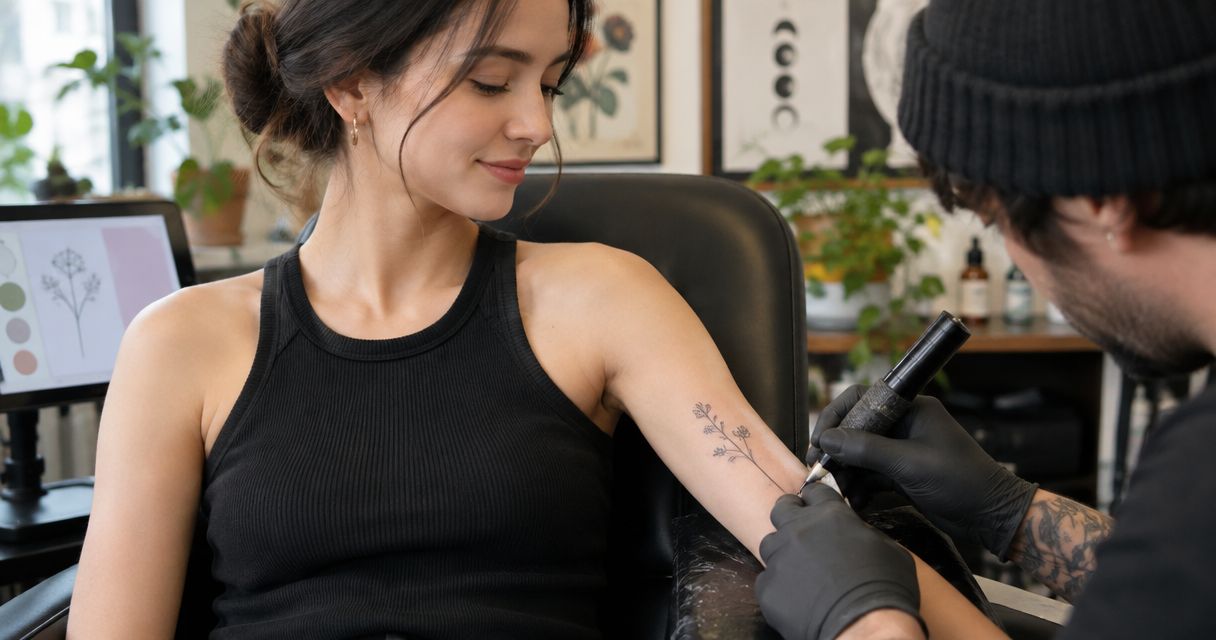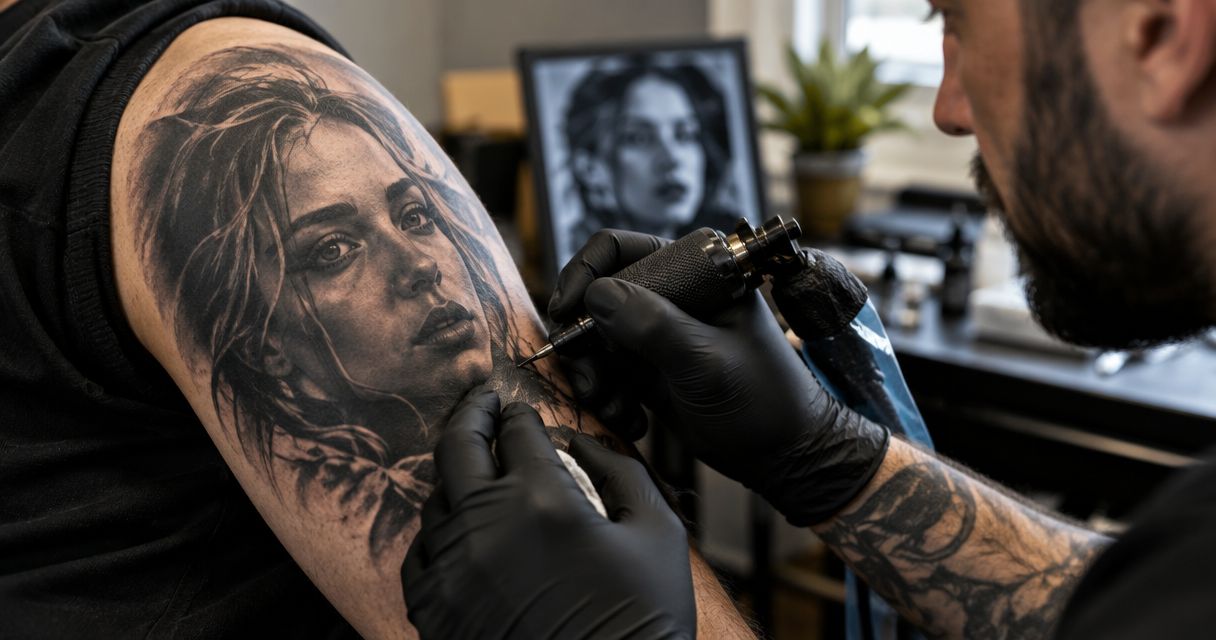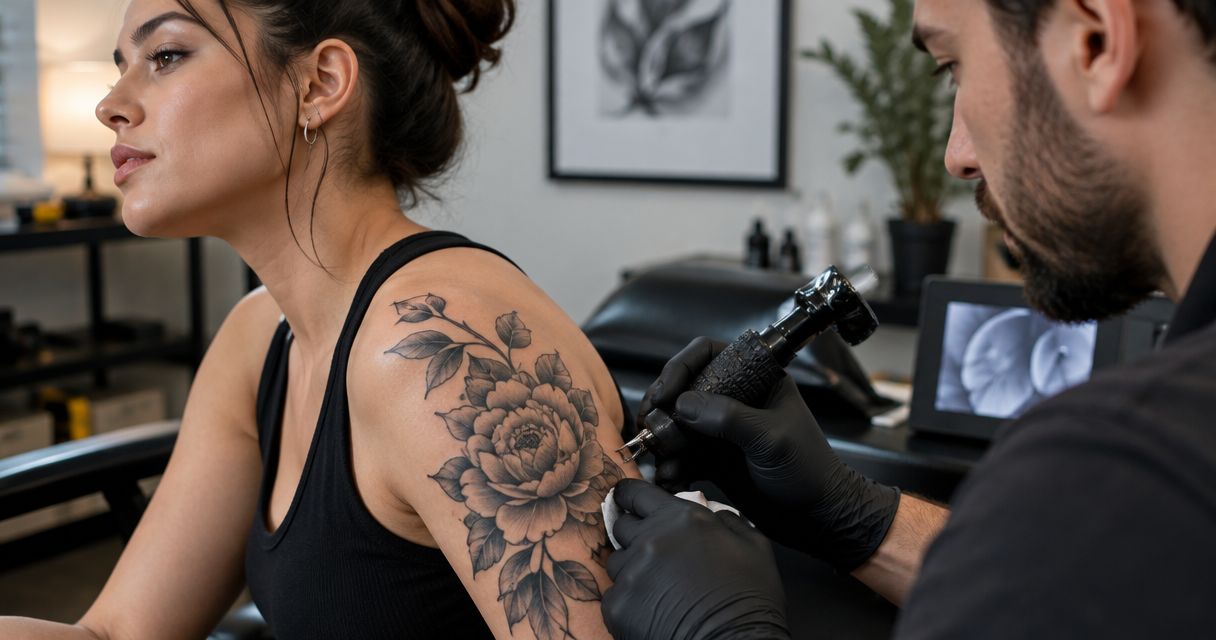
Best overall: botanical compositions. Best for personal meaning: realism portraits. Best for a restrained design: fine line illustrations. These black and grey tattoo design ideas for 2026 give you distinct starting points, with the strengths, limitations, and placement decisions that matter before a drawing becomes permanent.
- Botanical compositions lead these black and grey tattoo design ideas because leaves and stems support flexible placement.
- Realism portraits suit personal tributes; wildlife designs suit a strong animal focal point.
- Fine line illustrations favor restraint, while ornamental designs prioritize pattern and body placement.
- Lehighvalleyinktattoos specializes in custom black and grey, fine line, and realism tattoos in Emmaus, Pennsylvania.
Why this matters
A subject is not yet a tattoo design. A rose, a face, or a wolf still needs a clear silhouette, a balance of dark and light, and a placement that gives the drawing room to work.
The strongest choice for your 2026 tattoo is the idea you can explain without relying on a collection of unrelated references. Start with what matters, then decide what belongs in the composition. Adding detail is not the same as adding meaning.
Lehighvalleyinktattoos is a fit for clients seeking custom black and grey tattoos in Emmaus, Pennsylvania. Its stated specialties also include fine line and realism, making those useful directions to bring into a design discussion rather than treating every reference as the same style.
What makes the best black and grey tattoo design ideas
Use these criteria before choosing a subject. They apply whether you want a small standalone piece or a larger custom composition.
- Readable silhouette: The main subject should remain understandable without every small detail being visible.
- Tonal separation: Dark areas, softer shading, and open skin should serve different purposes rather than blend into one mass.
- Placement fit: The composition should respond to the shape and movement of the body area.
- Selective detail: Keep the marks that identify the subject; remove texture that competes with it.
- Personal relevance: Choose a subject you want to carry, not simply the reference with the most dramatic lighting.
- Clear scope: Decide whether the piece stands alone or needs to connect with future work.
For a 2026 consultation, bring these criteria alongside your references. The custom tattoo services at Lehighvalleyinktattoos include black and grey, realism, fine line, and large-scale custom pieces; the design discussion should establish which direction fits your idea.
Black and grey tattoo ideas at a glance
The ranking below separates designs by purpose. Botanical work is the default recommendation for flexibility, not a claim that it outranks every other subject on every body.
| Rank and idea | Best for | Standout design feature | Key limitation |
|---|---|---|---|
| 1. Botanical composition | A flexible first concept | Stems and leaves can guide the composition | Too many flowers compete for attention |
| 2. Realism portrait | A personal tribute | Expression creates a clear emotional focal point | Weak reference images restrict the design |
| 3. Wildlife composition | A strong animal focal point | Silhouette and gaze establish direction | Fur or feathers can overwhelm the subject |
| 4. Fine line illustration | A restrained standalone piece | Selective outlines with limited shading | Very small scale restricts detail |
| 5. Architectural scene | A connection to a place | Structure, perspective, and shadow | Dense geometry requires careful simplification |
| 6. Ornamental composition | Pattern-led placement | Repetition and spacing organize the design | Alignment needs careful stencil review |
1. Botanical compositions: best for a flexible first concept
Botanical tattoos use flowers, stems, leaves, and branches as the structure of the design. They suit black and grey because shape and shading can carry the subject without depending on color.
Choose a plant for its meaning or its form, then let that choice control the composition. A single bloom with a deliberate stem can say more than a bouquet assembled from unrelated images.
Botanical composition pros:
- Curving stems give the drawing a clear direction.
- Leaves offer opportunities to separate dark and light areas.
- The design can emphasize either realism or simpler illustration.
Botanical composition cons:
- Several equally prominent blooms can weaken the focal point.
- Dense overlapping petals leave less room for visual separation.
Best for: You want a recognizable subject with flexibility in shape and placement.
Ask for a clear hierarchy between the main flower and supporting foliage. If every leaf receives the same attention as the bloom, the design loses its center.
Verdict: Buy into botanical work when you want a flexible starting point with a clear visual structure.
2. Realism portraits: best for a personal tribute
A realism portrait centers on a recognizable person and a specific expression. In black and grey, the design depends on the relationship between facial structure, light, and shadow.
Start with the photograph, not a decorative frame. A meaningful image still needs visible features and useful lighting to serve as a drawing reference.
Realism portrait pros:
- A face gives the composition a natural focal point.
- Expression can communicate meaning without added lettering.
- A strong photograph gives the artist specific visual information.
Realism portrait cons:
- Blurred or heavily filtered references obscure important features.
- Reducing the portrait too far limits the space for likeness.
Best for: You want a tribute centered on a person rather than a collection of symbols.
For a portrait planned in 2026, bring the original image when possible, not only a screenshot of another tattoo. Discuss which features carry the likeness before adding dates, flowers, or background elements.
Verdict: Hold until the reference image and proposed scale support the portrait you want.
3. Wildlife compositions: best for a strong animal focal point
Wildlife tattoos use an animal's silhouette, posture, or gaze to organize the piece. Black and grey supports both close-up studies and compositions that include a restrained setting.
Choose the animal first, then choose what it is doing. A resting bird, a turning wolf, and a forward-facing big cat create different shapes even before shading begins.
Wildlife composition pros:
- The animal provides a recognizable central subject.
- Posture helps establish the direction of the design.
- Selective texture can distinguish fur, feathers, or scales.
Wildlife composition cons:
- Uniform texture can hide the animal's larger forms.
- A busy landscape can compete with the main subject.
Best for: You want an animal-led design with a decisive focal point.
Ask whether the background explains the subject or merely fills space. Keep it only when it strengthens the composition. An animal does not need a forest, moon, mountain, and compass to feel complete.
Verdict: Buy into wildlife work when the animal's shape matters more than surrounding decoration.
4. Fine line illustrations: best for a restrained standalone piece
Fine line illustrations emphasize selective outlines and controlled detail. Within black and grey tattoo design ideas, this direction suits subjects that remain understandable without extensive shading.
Think of a simplified branch, a small object with personal meaning, or a spare figurative drawing. The goal is not to compress a large realism composition into less space.
Fine line illustration pros:
- A limited composition keeps attention on the chosen subject.
- Open space becomes part of the design.
- Selective shading can add form without filling the entire outline.
Fine line illustration cons:
- Small scale restricts the number of distinct details.
- Faint reference drawings do not resolve placement or contrast decisions.
Best for: You prefer a quiet, clearly defined subject over a dense composition.
For your 2026 brief, distinguish between wanting a small tattoo and wanting a lightly drawn tattoo. Those are separate decisions. Let the subject determine which details deserve space rather than requiring every feature to fit a predetermined footprint.
Verdict: Buy into fine line illustration for restraint; skip it as a shortcut to miniature complexity.
5. Architectural scenes: best for a connection to a place
Architectural tattoos translate a building, doorway, skyline, or other built structure into a composition. Black and grey gives you a way to emphasize outline, perspective, and shadow rather than surface color.
Choose the feature that makes the place recognizable to you. It might be the roofline rather than every window, or an entrance rather than the entire street.
Architectural scene pros:
- A specific structure gives the design a clear identity.
- Strong outlines help organize the composition.
- Shadow can separate major building forms.
Architectural scene cons:
- Repeated windows and masonry can crowd a small design.
- Combining photographs from different viewpoints complicates perspective.
Best for: You want to mark a meaningful place without relying on coordinates or a written name.
Bring a clear photograph and identify the indispensable feature. Discuss what can be simplified before requesting the full facade. The drawing should preserve the identity of the place, not reproduce every mark in the photograph.
Verdict: Hold until the essential architectural features are clear and the perspective is consistent.
6. Ornamental compositions: best for pattern-led placement
Ornamental black and grey tattoos organize the design through repeated shapes, spacing, and deliberate symmetry or asymmetry. Unlike a portrait or wildlife piece, the pattern itself is the subject.
Choose this direction when you care more about how the tattoo occupies the body than about representing a person or object. Placement is part of the design, not a final administrative choice.
Ornamental composition pros:
- Repetition gives the piece a consistent visual language.
- Open spaces can separate patterned areas.
- The composition can respond closely to body contours.
Ornamental composition cons:
- Small alignment changes can alter the balance of a symmetrical design.
- Excessively dense repetition can obscure individual shapes.
Best for: You want a pattern-led tattoo whose placement carries the composition.
Review the stencil in a relaxed posture and discuss how the pattern meets surrounding anatomy or existing tattoos. Do not approve symmetry from a close-up view alone.
Verdict: Buy into ornamental work when you are willing to give placement the same attention as the drawing.
How these ideas are ranked
Botanical compositions lead because they offer several ways to organize a recognizable subject. Portraits follow for personal meaning, while wildlife, fine line, architecture, and ornament each serve a distinct design priority.
This 2026 ranking is a design-selection guide, not a report of tattoo testing or a prediction of individual results. The criteria are silhouette, tonal separation, placement, selective detail, personal relevance, and scope. Your strongest choice is the one that meets your priorities without forcing the subject into an unsuitable format.
Turn your preferred idea into a useful design brief
A useful brief gives the artist decisions to work with, not an instruction to merge every saved image. Use this sequence before discussing the final drawing.
- Choose the subject. Name 1 primary subject and explain why it matters. Keep secondary elements optional.
- Select references. Bring 3 reference images with different jobs: subject, shading, and overall composition. Explain what you want from each.
- Confirm placement. Identify the body area and whether the tattoo must relate to existing or future work.
- Review readability. Assess the proposed composition at 2 viewing distances: close enough to inspect detail and far enough to see the whole piece.
These are planning recommendations, not studio submission requirements. They help separate your nonnegotiable idea from details the artist needs room to resolve.

Which black and grey tattoo idea should you choose?
Choose a botanical composition if you remain undecided. It gives you a clear subject while leaving room to discuss realism, illustration, direction, and placement.
Choose a portrait when a particular person is the reason for the tattoo. Choose wildlife for an animal focal point, fine line for restraint, architecture for a meaningful place, and ornament for pattern-led placement. Do not make a portrait carry the expectations of an ornamental piece, or ask a small illustration to contain a full scene.
Lehighvalleyinktattoos offers custom black and grey tattoos alongside fine line and realism work. Bring the direction that fits your intent, then resolve the drawing around the body area rather than treating a reference image as a finished stencil.
FAQ
What are the best black and grey tattoo design ideas for a first tattoo?
Botanical compositions and restrained illustrations are useful starting points because you can define a clear subject without a crowded scene. Choose between them based on whether you prefer shaded form or selective outlines.
Is a realism portrait better than a symbolic tattoo?
A realism portrait is the better choice when a specific person's likeness is central to the meaning. A symbolic design fits a brief that does not depend on reproducing a face.
Can a small black and grey tattoo include lots of detail?
A small tattoo has limited room for distinct details. Ask the artist which features identify the subject and which should be removed or given more space.
What should I bring to a black and grey tattoo consultation?
Bring a clear subject, your intended placement, and references that show what you like. Explain whether each image represents the subject, shading, or composition rather than asking for an exact copy.
Should I add a background to an animal tattoo?
Add a background only when it strengthens the animal's composition or meaning. Keep the animal as the focal point rather than filling every open area.
How do I choose the placement for an ornamental tattoo?
Choose ornamental placement together with the pattern. Review how its alignment and spacing relate to your anatomy and any existing tattoos.
Where can I discuss a custom black and grey tattoo in Emmaus?
Lehighvalleyinktattoos is a custom tattoo studio in Emmaus, Pennsylvania, specializing in black and grey, fine line, and realism tattoos. Bring your subject and placement preferences into the discussion.
One last thing
Before approving a composition, ask what can be removed. If eliminating a background, extra flower, or decorative object makes the main subject clearer, that element was competing with the design.
For a tattoo you plan in 2026, make clarity the standard. The subject deserves enough space, and the supporting details need a reason to stay.