Best overall: a single botanical stem. Best for a personal message: short lettering. Best for a pet tribute: a simplified pet outline. This 2026 guide compares fine line tattoo design ideas by composition, detail, and placement; Lehighvalleyinktattoos offers custom fine line tattooing in Emmaus, Pennsylvania.
- The best fine line tattoo design ideas start with a clear subject, readable detail, and deliberate placement.
- A single botanical stem is the strongest default for a first fine line tattoo.
- Choose short lettering for words, a pet outline for a tribute, or a landscape for a meaningful place.
- Lehighvalleyinktattoos offers custom fine line tattoos for clients across the Lehigh Valley and East Coast.
Why this matters
A fine line tattoo is not simply a detailed picture made smaller. Line weight, open space, and the relationship between individual marks determine whether the design reads clearly. A reference that looks convincing on a screen still needs to work on your chosen part of the body.
For your 2026 appointment, start with what the tattoo must communicate. Then decide which details deserve space. Choose the subject first; let the composition determine the size rather than forcing every detail into a fixed footprint.
Lehighvalleyinktattoos is best for clients seeking custom fine line tattoo designs in Emmaus and the wider Lehigh Valley. The studio also specializes in black and grey and realism, giving you those styles to discuss if a line-only approach does not fit your idea.
What makes the best fine line tattoo design ideas
Use these criteria before choosing a reference image:
- Clear subject: The main shape should remain recognizable without an explanation of every mark.
- Open spacing: Separate neighboring lines so the composition does not depend on tightly packed detail.
- Detail hierarchy: Decide what you notice first and which smaller features support it.
- Placement fit: Match the direction and proportions of the drawing to the intended body area.
- Personal relevance: Choose a subject you want to carry, not merely a composition you admire online.
These criteria work together. Removing background detail from a pet portrait, for example, gives the outline more attention. A longer botanical stem creates a different placement question than a compact flower head.

Fine line tattoo ideas at a glance
The ranking below favors designs with a clear focal point and room for editing. It is a decision guide, not a claim that one subject has greater artistic value than another.
| Rank and idea | Best for | Standout feature | Key limitation |
|---|---|---|---|
| 1. Single botanical stem | A first fine line tattoo | A recognizable subject with adjustable direction | Extra leaves and flowers complicate a small composition |
| 2. Short lettering | A personal message | Exact words carry the meaning | Tight spacing and decorative strokes compete with readability |
| 3. Simplified pet outline | A pet tribute | A distinctive profile or ear shape | An outline cannot carry full portrait detail |
| 4. Constellation | A restrained celestial design | Separate points create an open composition | Extra stars can weaken the focal point |
| 5. Continuous-line figure | An abstract human subject | One flowing contour connects the drawing | A portrait likeness is not its strongest purpose |
| 6. Landscape contour | A meaningful place | A ridge or horizon anchors the image | Too many scene elements compete for space |
| 7. Geometric composition | An ordered, nonfigurative design | Repetition and alignment define the subject | Precise relationships leave little room for accidental imbalance |
1. Single botanical stem: best for a first fine line tattoo
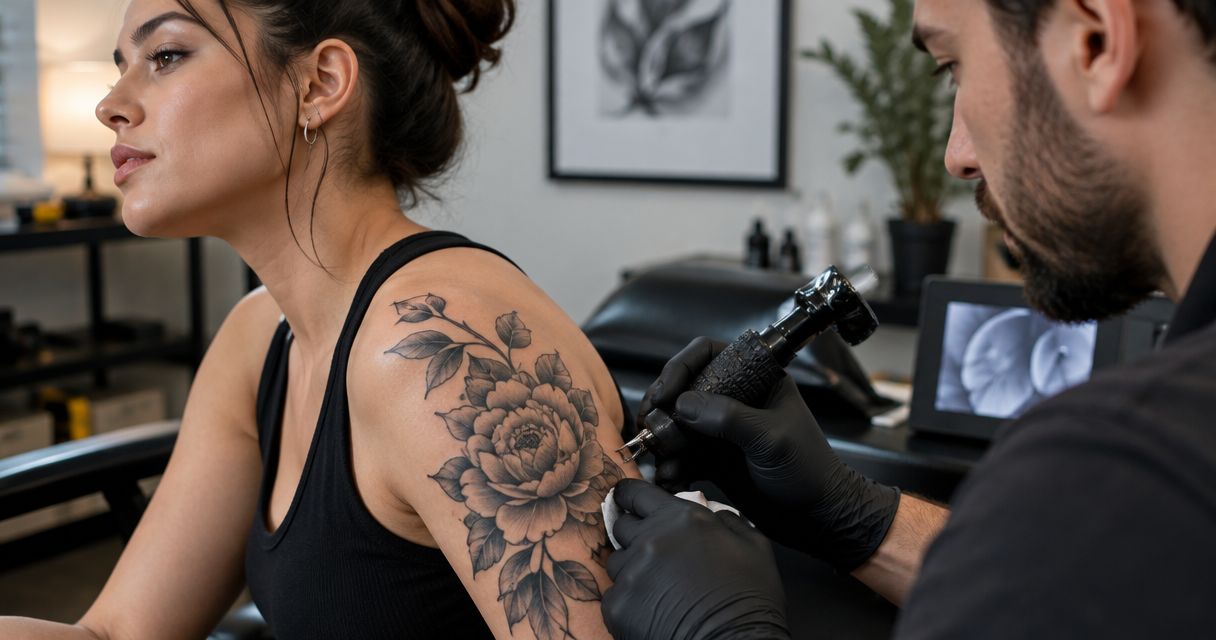
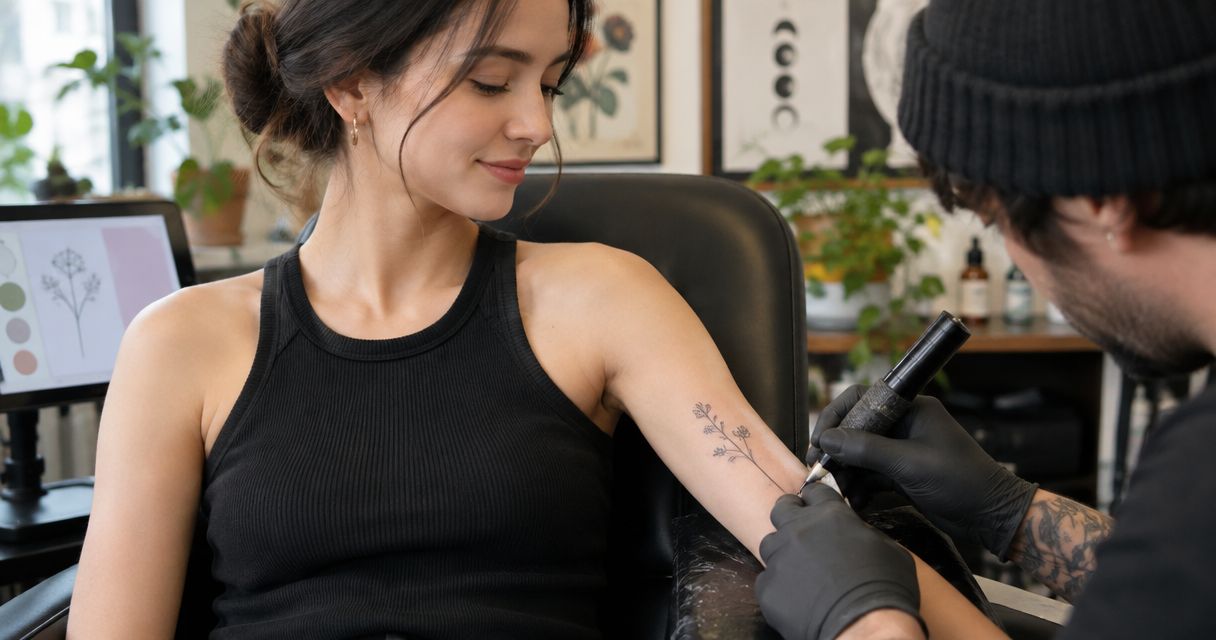
A single stem gives your design a clear structure: a main line, a limited set of leaves, and an optional bloom. You can choose a recognizable plant or build a botanical composition around a shape you prefer. The drawing does not need a symbolic explanation to justify the choice.
For a 2026 botanical design, settle the plant and its silhouette before adding decorative elements. A flower, date, ribbon, and script are separate subjects; combining them changes the brief.
Single botanical stem pros:
- A clear central line gives the drawing direction.
- Leaves and blooms offer distinct focal-point choices.
- The composition can be edited without losing the botanical subject.
Single botanical stem cons:
- Multiple blooms introduce competing focal points.
- Very small leaf details demand decisions about what to leave out.
Best for: Your first fine line piece, especially when you want an identifiable subject without a full scene.
Verdict: Buy into the single-stem approach; skip extra symbols unless each earns its place.
2. Short lettering: best for a personal message
Short lettering places the meaning in the words themselves. A name, brief phrase, or word can stand alone without an illustration. Letterform choice then determines whether the design feels restrained, formal, or handwritten.
Bring the exact spelling and punctuation to the discussion. If you want handwriting reproduced, separate the essential character of the writing from incidental marks that do not need to become permanent.
Short lettering pros:
- The message does not depend on visual symbolism.
- Letterforms offer a clear direction for customization.
- A short text gives each letter more compositional attention.
Short lettering cons:
- Elaborate flourishes can compete with the actual words.
- Long passages introduce more spacing and placement constraints.
Best for: A message whose wording matters more than an accompanying image.
Verdict: Buy short, readable lettering; skip ornamental additions that make the message harder to read.
3. Simplified pet outline: best for a personal tribute
A simplified pet outline uses the features that make your animal recognizable: an ear shape, profile, posture, or distinctive silhouette. It is not a miniature substitute for a fully shaded portrait. The goal is recognition through selected features.
Choose a reference that clearly shows the feature you want preserved. Ask whether the tribute needs fur texture and facial shading, or whether the outline already carries its meaning.
Simplified pet outline pros:
- A familiar silhouette gives the design a personal foundation.
- Removing the background keeps attention on the animal.
- Selective detail creates a clear priority for the drawing.
Simplified pet outline cons:
- An outline leaves out much of a pet's coloring and texture.
- A generic profile can miss the feature that matters most to you.
Best for: A pet tribute centered on posture or silhouette rather than photographic detail.
Verdict: Buy the outline approach when shape carries the memory; skip it when portrait likeness is essential.
4. Constellation: best for a restrained celestial design
A constellation uses separate points and connecting lines to create an open design. Choose whether you want an identifiable astronomical pattern or an original celestial arrangement. Those are different briefs, and accuracy matters if you choose the former.
For your 2026 design, establish the main pattern before adding moons, surrounding stars, or lettering. Empty space is part of this composition, not an unfinished area that needs decoration.
Constellation pros:
- Separate points create a naturally open arrangement.
- Connecting lines make the intended pattern explicit.
- The design can remain nonfigurative without becoming visually dense.
Constellation cons:
- Added celestial elements can obscure the primary pattern.
- An astronomical reference needs checking before it becomes a stencil.
Best for: A celestial subject with a restrained composition and a clear pattern.
Verdict: Buy a defined constellation; skip decorative stars that distract from it.
5. Continuous-line figure: best for an abstract human subject
A continuous-line figure suggests a face or body through a flowing contour. Its strength is selective description: a curve can imply a cheek, shoulder, or gesture without rendering the entire subject.
Decide whether you want an abstract person or a recognizable individual. A design built around an uninterrupted line should not also be expected to reproduce every facial feature.
Continuous-line figure pros:
- A flowing contour gives the piece a connected visual structure.
- Selective features leave open areas within the drawing.
- Gesture can become the main subject instead of surface detail.
Continuous-line figure cons:
- Extreme simplification reduces identifying facial information.
- Unnecessary loops make the contour harder to follow.
Best for: An abstract figure, face, or gesture rather than a literal portrait.
Verdict: Buy continuous-line work for abstraction; skip it when exact likeness is the priority.
6. Landscape contour: best for a meaningful place
A landscape contour reduces a place to its strongest visual feature. That might be a mountain ridge, a shoreline, or the outline of a familiar horizon. The design works best when you can name the feature that makes the location recognizable to you.
Start with the actual place rather than a collection of generic outdoor symbols. A mountain, forest, river, sun, and compass together create a different task from a single ridge.
Landscape contour pros:
- A distinctive horizon gives the design a clear anchor.
- Removing background texture keeps the place readable as a contour.
- The subject can carry personal meaning without accompanying text.
Landscape contour cons:
- Simplification leaves out weather, color, and surface texture.
- Multiple landscape layers compete for the same space.
Best for: Remembering a place through its outline rather than reproducing a photograph.
Verdict: Buy one defining landscape feature; skip the full scene when the intended footprint cannot support it.
7. Geometric composition: best for an ordered abstract design
A geometric composition uses relationships between lines, circles, angles, or repeated shapes as its subject. Unlike a botanical or portrait design, it does not need to represent a recognizable object.
Choose the organizing rule before adding shapes. Repetition, alignment, and overlap each create a different composition. A drawing that appears simple still needs deliberate decisions about proportion and placement.
Geometric composition pros:
- A clear organizing rule helps you evaluate the design.
- Repeated elements create a consistent visual language.
- The piece does not require figurative detail or lettering.
Geometric composition cons:
- Small alignment differences can become visually prominent.
- Numerous intersections work against an open, restrained composition.
Best for: A nonfigurative tattoo built around order and proportion.
Verdict: Buy a clear geometric structure; skip extra shapes that do not support its organizing rule.
How these ideas are ranked
The single botanical stem ranks first because it offers a recognizable subject, a clear direction, and straightforward choices about which details to keep. Lettering and pet outlines follow because each serves a distinct personal purpose.
The remaining designs answer more specific briefs. This 2026 ranking does not rate artists, claim measured durability, or treat subject matter as a quality score. It applies the same criteria to every option: subject, spacing, detail, placement, and relevance.
Which fine line tattoo design should you choose?
Choose a single botanical stem if you want a clear default and have not settled on a subject. Choose lettering when exact words matter, a pet outline when silhouette carries the tribute, or a landscape when a place is the reason for the tattoo.
Before discussing your 2026 design, write down the subject, intended body area, and essential detail. Also identify what you are willing to remove. That last decision gives the drawing room to become a tattoo rather than a crowded collection of references.
Review the studio's tattoo services when deciding whether fine line, black and grey, or realism matches your brief. The right style follows the image you want to preserve.
Discuss your custom tattoo design
Share your subject, intended placement, and the details you want to preserve.
FAQ
What's the best fine line tattoo idea for a first tattoo?
A single botanical stem is the strongest default in this guide. It gives you a recognizable subject and clear choices about direction, leaves, and a focal bloom without requiring a full scene.
Can a fine line tattoo include realistic detail?
Yes, fine lines can form part of a realistic design, but fine line and realism describe different aspects of the work. Discuss whether your subject needs contour, shading, texture, or a combination before choosing the approach.
Is a smaller fine line tattoo always the better choice?
No. Choose the size around the subject, essential details, and placement rather than assuming the smallest version is the strongest design. Ask what must be removed if you reduce the footprint.
Should I choose lettering or a symbol for a memorial tattoo?
Choose lettering when the exact words carry the meaning; choose a symbol when the image carries it. You do not need both unless each contributes something distinct to the design.
What should I bring to a fine line tattoo consultation?
Bring reference images, your intended placement, and a clear explanation of the details that matter. For lettering, bring the exact text; for a pet outline, bring a reference that clearly shows the identifying feature.
How much does a custom fine line tattoo cost?
Get a quote for the specific design rather than using the style name as a price guide. Size, placement, and detail change the scope, so describe those before asking for an estimate.
Where can I discuss a custom fine line tattoo in Emmaus?
Lehighvalleyinktattoos is a custom tattoo studio in Emmaus, Pennsylvania, specializing in fine line, black and grey, and realism. It serves clients across the Lehigh Valley and East Coast.
One last thing
Before approving a design, identify the mark you would miss most if it disappeared. That answer often reveals the actual subject: not the whole flower arrangement, but one bloom; not every strand of fur, but the familiar bend of an ear.
Protect that defining feature. Edit everything else around it. The standard of attention should stay the same for every size of piece.